Bharat Next – PLASTINDIA 2026 One Of The World’s Largest Show
Bharat Next – PLASTINDIA 2026 One Of The World’s Largest Show
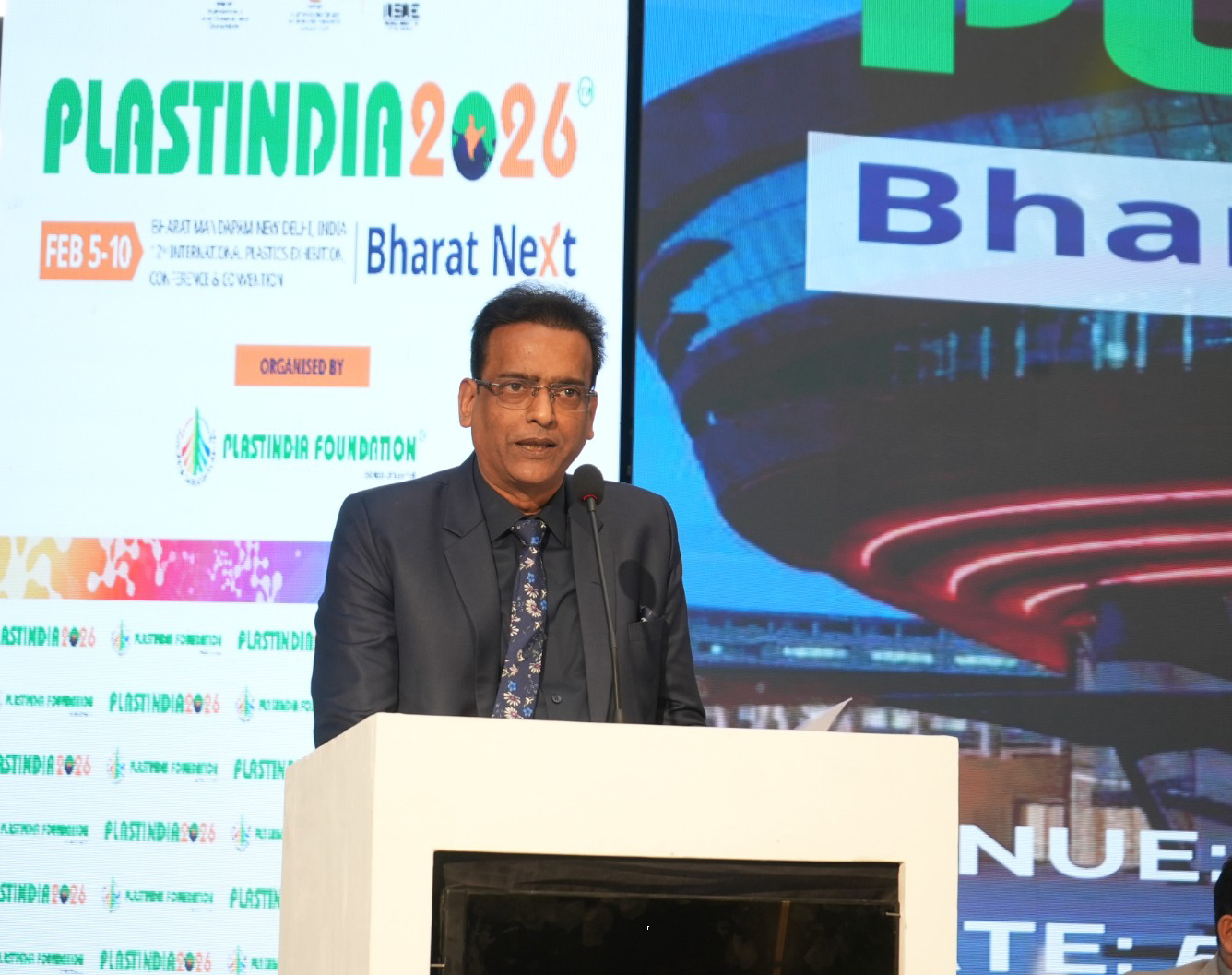
Growth Dialogue with Mr. Alok Tibrewalla, Chairman, National Executive Council, PlastIndia 2026 Explained to Mr. Ginu Joseph (Text by Anagha Salvi Extract from Modern Plastics TV)
‘‘Don’t miss this. Don’t miss the opportunity of coming to PlastIndia 2026 and see for yourself, what is the bucket full of opportunities for next 15 years. So, Bharat Next is all about next 10-15 years. Bharat is growing, India is growing and don’t miss the opportunity to grow together. ’’
Tell us about you know how this idea of Bharat Next came into your mind or the team PlastIndia’ s mind?
First of all, please accept my heartiest congratulations, wishes and appreciation for all the team you have at Modern Plastics who are doing some wonderful work for plastic industry. So, thank you for everything that happens at Modern Plastics. Thank you.
So, I will plainly say it is very much inspired by our Honourable Prime Minister Mr. Narendra Modiji, because a man who is working 18 hours is talking about India 2047. It is time that every Indian should start thinking what is ahead for Indians and Bharat Next is all about how do you see India in 10 years and how do you see India when you complete 100 years of independence. So, that is where this thought came to me. So, purely dedicated to Honourable Prime Minister. Because we believe we should start thinking 5 years, 10 years and 15 years from now instead of short term thinking. PlastIndia is in the next edition will be the 12th edition.
What are the changes compared to the previous editions?
PlastIndia 2026 is just not about an exhibition, it is about taking an exhibition beyond and about doing everything right which actually fulfils the purpose of having a show like this.
So, what you see in Bharat PlastIndia 2026 is while we proudly say it is the biggest show
You’re also researching graded structures. What’s behind that?
Dr. Hill: With graded layers, we can, starting from the substrate outward, increase the hard phase content where we need the final properties. The advantage: on the outside it’s then hard and wear-resistant. Associated with this, I do have poorer toughness, but I really only have the poor toughness on the outside. The rest of the component is still tough, and if a crack forms, it can be compensated for and stopped. This way we can design the properties across the component height. What we can do macroscopically in the welding process, we’re now trying to build up additively as well—in smaller and more complex ways. It is a really interesting topic.
That sounds like enormous, and especially time-consuming, development effort. What role does digitalization play in getting to the goal faster in product development and optimization?
Dr. Hill: A very large one by now. People have been trying for quite some time to monitor the process very precisely. In the powder bed process, for example, the melt pool is monitored very specifically to determine: Am I deviating somehow, in temperature or other parameters, where a pore, defect, or crack could later develop? There’s increased focus on improving the prediction. The next step is then for the system to automatically adjust the parameters when it determines that you’re heading toward a limit violation. This is particularly interesting with complex components with large transitions or thinwalled areas. So said, a lot of research projects are being carried out for this purpose by research institutions and universities.
Speaking of AI—how do you see its influence on additive manufacturing?
Dr. Hill: I’ve seen promising approaches that combine real-time monitoring like melt pool cameras with AI-supported evaluation. The system detects defects in real time, evaluates their influence on properties, and in a second step adjusts the printing parameters-possibly even only locally. This can be done wonderfully via an AI-controlled system. This is currently being researched. In general, there’s a strong focus on: What sensors are available, what feedback do they provide, and what can I derive from that for controlling and optimizing the process?
Because sensors are usually not cheap, the other question at this point is always one of economic viability.
Dr. Hill: Completely correct. You can install a lot of sensors, but if a printer costs 50,000 euros for instance and I install 10,000 euros worth of sensors, it may no longer be so economical—even if it’s technically perhaps highly interesting. I always have to look through the application lens and ask: What is actually necessary? What do I need to measure to control my process well? In the end, an economical product must result. We see the same thing with powder specifications. People are now trying to very strongly limit secondary elements like oxygen or nitrogen. You can work with protective gas in the furnace, smelt under vacuum, switch from nitrogen to argon to achieve higher purity via atomization. But is that technically really sensible? Am I thereby producing a product that generates real added value, or am I just making it more expensive?
Speaking of costs—what about series production?
Dr. Hill: The leap from prototype to series—the scaling—is always the big hurdle. Often people only think about the quantities or the manufacturing costs per part—all correct, but you mustn’t forget quality assurance. How is the quality of finished components checked? How is it ensured that the process runs stably? Is the material specification defined? Especially in aerospace to the venue. PlastIndia is giving them free space. PlastIndia is also covering all the expenses.
The idea is to give them audience to those 6-lakh people or to the captains of industry, because PlastIndia, we clearly believe what we have seen in the past. Many, many brilliant ideas and innovations have died in classrooms and college corridors because of financial pressure. we are trying to do hand holding for those people. So, when they come, there will be many, many exciting things for the people of industry to talk to them about the young minds, young ideas and then probably we will bring a change. We may create 10 more new entrepreneurs to this. Bharat Next is all about creating entrepreneurship.
As you said, there will be 6 lakh visitors, what will be the future you are looking for PlastIndia growth for Industry?
PlastIndia 2026, the response we have got has clearly drawn the line like you have 80,000 square meters allocated, you have 10,000 to 50,000 square meter in pipeline and still we are receiving calls every day for space. So, the space requirement itself tells how this industry is swelling. So, to me every 3 years or every 2 years, you will see a radical change in the terms of technology, in terms of scaling up, in terms of material and in terms of manpower.
This industry probably is the most dynamic industry you have in the world, which is changing at a very, very fast pace, So, probably you will need, the frequency of exhibition has to go up, like has to come down.
You will have more space required for putting up such mega shows. The incoming chairman, I think at PlastIndia, the biggest challenge will be, how will you fit in people who are interested in putting up show at PlastIndia. So, that is the size of industry.
What message you want to give to the Indian entrepreneurs?
Indian entrepreneurs, the simple message is, when we say Bharat Next, we did not say Plastic Next. Because we seriously believe and it is a fact that the future is about plastics.
Anything, you talk about medical, you talk about automation, you talk about defence, technology, irrigation, sanitation, plastic is integral. So, Bharat Next cannot be without use of more plastics.
India is going to see more consumption. Hence, there will be tremendous exponential opportunities for coming to the business of processing in plastics. So, this is your time. India is going to see this growth in next 15 years.
#PLASTINDIA 2026 #Modernplasticsindia#Pasticsnews #ModernPlasticsIndiaMagazine
#PrintPublication #PrintMagazine #Injectionmouldingworld